
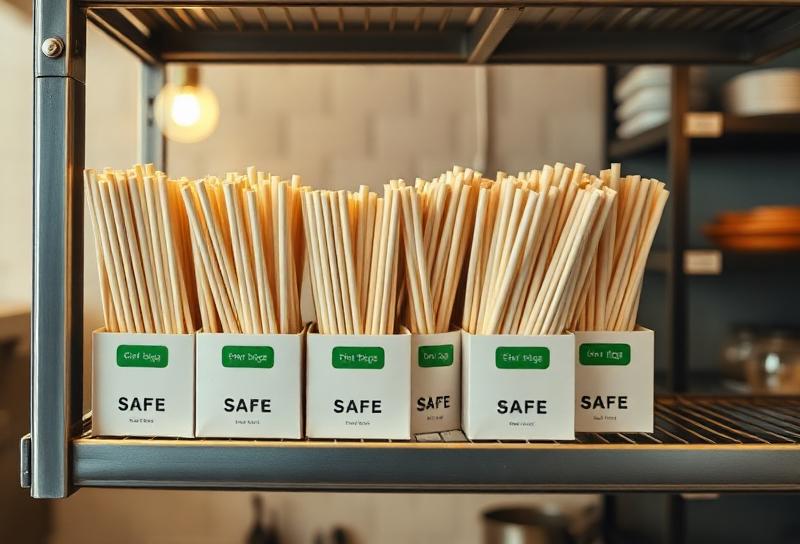
Proper storage keeps your sugarcane straws in perfect condition. Learn best practices for humidity, shelf life, and hygiene standards.
Sugarcane straws are durable, but they are plant fibre, and plant fibre responds to its environment. Almost every complaint we hear about fibre straws underperforming traces back to how the cases were stored rather than the straws themselves. Get storage right and the product performs the way it did in the sample you tested.
The one rule: keep them dry and sealed
Bagasse fibre will slowly take up moisture from the air. A straw that has been sitting in an open carton in a humid store room for a month has already absorbed some of the moisture it was meant to resist in the glass. It will still work, but it will not feel as rigid as a straw from a sealed case.
So the single most useful habit is simple: keep cases sealed until you need them, and only open the box you are currently drawing from.
Where to put the boxes
- Off the floor. Pallets, shelving or a dunnage rack — anywhere that avoids mopping water and cold concrete.
- Away from steam. The dish pit, the pasta station, the glass washer and the ice machine are all moisture sources. Keep straws in a different part of the store room.
- Out of direct sunlight. Sun through a window will not destroy a straw, but it fades printing and warms the carton unevenly.
- In a cool, ventilated, ambient-temperature space. Straws need no refrigeration and should never go in a cold room, where condensation forms every time the door opens.
- Never near cleaning chemicals. Fibre picks up odours. Keep straws away from bleach, degreaser and sanitiser storage.
At the counter
Decant a working quantity into a covered dispenser and refill from a sealed case. An open carton behind the bar is both a moisture problem and a hygiene problem — it invites hands into the middle of the stock.
If you serve at markets, outdoor events or anywhere without a controlled environment, individually wrapped straws solve both issues at once. Our bubble tea straws come in a wrapped option for exactly this reason, and it is the version most operators choose when straws are handled by customers rather than staff.
Hygiene and food safety
Treat straws as single-use food-contact items, because that is what they are. A few habits that hold up to an audit:
- Staff handle straws with clean hands, or use a dispenser that lets customers take one without touching the rest.
- Never return a straw to stock once it has left the dispenser.
- Store straws above and away from raw food, never below anything that could drip.
- Keep the original carton or record the batch information so stock can be traced if you ever need to.
- Rotate stock first in, first out. Label cartons with the date received when they arrive.
Shelf life
Stored sealed, in dry ambient conditions, sugarcane straws have a long usable life — they are dry fibre with nothing in them to spoil. The limiting factor is almost always moisture exposure, not age.
The practical implication is that buying in bulk is safe if your store room is dry, and risky if it is not. If your only storage is a humid space near the dish pit, buy smaller quantities more often rather than a pallet you will be drawing from for a year.
Handling damaged or discoloured straws
If a case has been through water damage, discard it rather than trying to dry it out. Fibre that has been wet and re-dried loses rigidity and may show discolouration or odour. It is a small loss compared with serving a straw that collapses in a customer's drink.
Minor colour variation between batches is normal and not a defect — bagasse is an agricultural material and its natural tone varies slightly. Rigidity and performance are what to judge.
Disposal
Store used straws with your organics if you have a commercial composting collection — that is where a certified compostable straw delivers its benefit. Ours are TUV certified compostable, break down within 90 days in commercial composting conditions, and are PFAS-free, so they are appropriate for an organics stream. If organics collection is not available in your area, they go to general waste, and it is worth asking your waste contractor whether an organics service can be added.
Questions about storage in a specific setup? Email [email protected] and describe your store room — we would rather help you store them properly than replace a damaged pallet.